How to Make Viral Stick Figure Series with AI: the Stickocalypse Case
A YouTube channel with five videos and stick figures for a cast has a Short with 4.2 million views. It is called Stickocalypse and it tells a zombie survival story in parts: a farmer, his dog, a neighbor who shows up covered in blood and a fence that does not hold.
No actors, no shoot, no hard visual style. Just a very well built script and editing that never lets you breathe. Both can be learned, and the whole process can be done in Vuela. In this article we take it apart and show you the series we made following its formula.
The case: 4.2 million views with five videos
These are the numbers of @Stickocalypse_Shorts, checked on October 19, 2026:
| Episode | Views |
|---|---|
| Part 1, "The Last Farm" | 4.2M |
| Part 2, "The Barn Wasn't Empty" | 270K |
| Part 4, "The City Went Silent" | 142K |
| Part 5, "She Saw Her Sister in the Convoy" | 60K |
The channel has 35,600 subscribers. The drop from Part 1 to Part 2 says a lot about the format. Our reading: Part 1 is the one the algorithm shows to people who do not know the channel, and the next parts live mostly on viewers who come back. That is why every part needs its own hook, even when it continues the story.
What a stick figure survival series is
Shorts of 60 to 100 seconds with stick figures seen from the side, at ground level, in sets drawn as flat layers of color with fog. A narrator tells the story in the third person and the captions are burned into the video. The story moves forward in parts and every part ends on a cliffhanger.
The drawing is simple on purpose: it reads in a second on a phone screen and leaves the story in charge.
Why it works: the script formula
We transcribed its episodes and they all follow the same skeleton. These are the seven pieces:
- A counterintuitive hook in the second person. It opens with "if the zombie apocalypse starts while you're on a farm", tells you not to do the obvious thing (run to town) and promises you are in a good place to survive, except for one very stupid mistake. The viewer stays to find out what the mistake is.
- The main character stands in for the viewer. Then it switches to the third person: Eli's first instinct is to drive into town. Don't. The narrator corrects the character the way it would have corrected you.
- A practical guide dressed up as a story. There is a time limit (30 minutes before the power grid fails), a priority (water first), the real mechanics (the well runs on an electric pump) and a cost to every decision (a generator can be heard hundreds of meters away).
- Concrete numbers. 30 chickens, 12 cattle, one horse and a dog that barks at everything. Numbers make the story believable and give people something to comment on.
- Short lines and rule lines. One-word lines ("Don't", "Nothing", "Silence") and sentences that work on their own, like a survival rule. Those are the ones people repeat in the comments.
- The mistake is paid in the next part. The generator noise in Part 1 is what brings the neighbor in Part 2. And the others.
- An ending with a concrete threat. "There was only one problem. Someone was already inside the fence." There is never a "what would you do?" at the end: the hook is the threat.
The cast is minimal: the main character, someone who arrives and an animal or an object that works as an alarm.
The editing: a new shot every 2-3 seconds
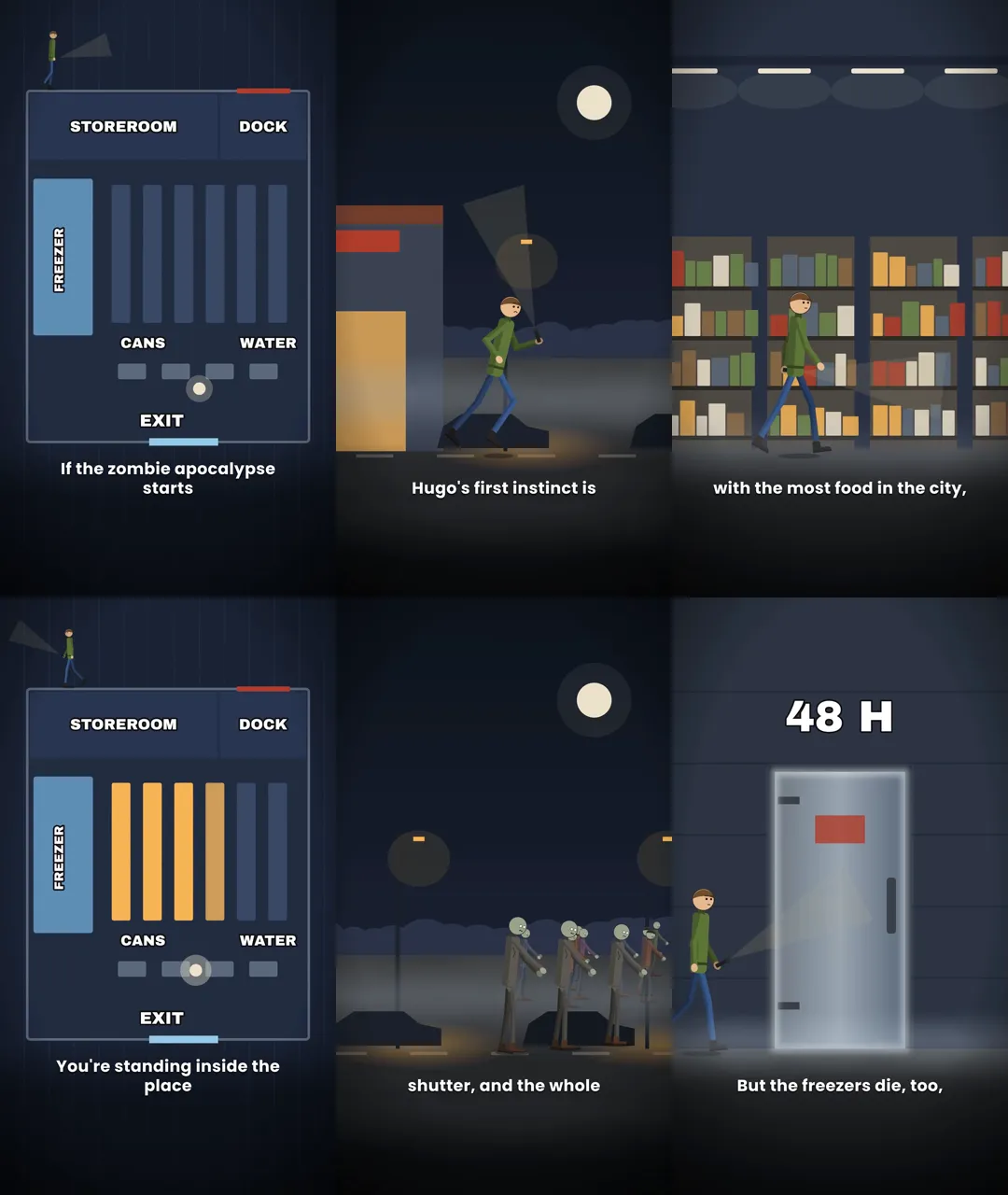
The other half of the success is the edit. No framing lasts more than three seconds, and it always mixes the same shot types:
- A top-down map of the place with the supplies labeled. It situates the viewer and comes back every time the place changes.
- A wide shot from the side, with the horde small in the fog.
- A close-up of the main character: the brows carry the fear.
- An insert of one object big on screen: a lock, a fuse box, a counter.
- An over-the-shoulder shot towards the threat.
And every episode has at least three different settings. This is how it looks in our series:
How to replicate it in Vuela, step by step
The point is to replicate the process, not the channel. Vuela has a tool made for it, Replicate an Animated Channel: it studies the channel you like and builds you your own channel that works the same way. These are the steps we followed to make "The Last Supermarket".
Step 1: paste the channel's URL into "Replicate an Animated Channel"
Vuela lists its videos and Shorts, picks the three most viewed, transcribes their narration and takes frames from them. With that it designs an original channel: a premise, the rules of its world, a cast with its own names and looks, topic ideas and, most importantly, how its scripts are told. It takes about 10 minutes and costs 65 credits.
With Stickocalypse it studied Parts 1, 2 and 4 and got the whole formula:
- a conditional, second-person hook with a concrete place;
- the main character's first instinct, cut with a dry "No";
- numbered priorities, each with its practical reason;
- everyday numbers and very short sentences;
- a two-beat ending: "There was only one problem", then a threat that is already there.
Those script notes are editable, and the channel follows them in every video.
Step 2: fit the channel to your series and pick "Animated stick figures"
Change whatever you want: the place, the premise, the cast. We turned it into a supermarket with Hugo, the night-shift stocker, his coworker Tomás and Lucía, the butcher. Pick the narrator voice.
Under "How the videos are drawn", choose Animated stick figures. The channel's videos are then not made from its painted pictures: stick figures are animated in code from each character's description, with joints, hordes and a new shot every 2-3 seconds. Each frame is drawn from that code, so the characters look the same in every shot and nothing melts or morphs.
Step 3: write each part with the channel and review it
Give it the topic or an outline of the part and the channel writes the script with its formula, about 150 words for 60 seconds (12 credits). Review it before generating: it is your series. This is our Part 1 script, 155 words:
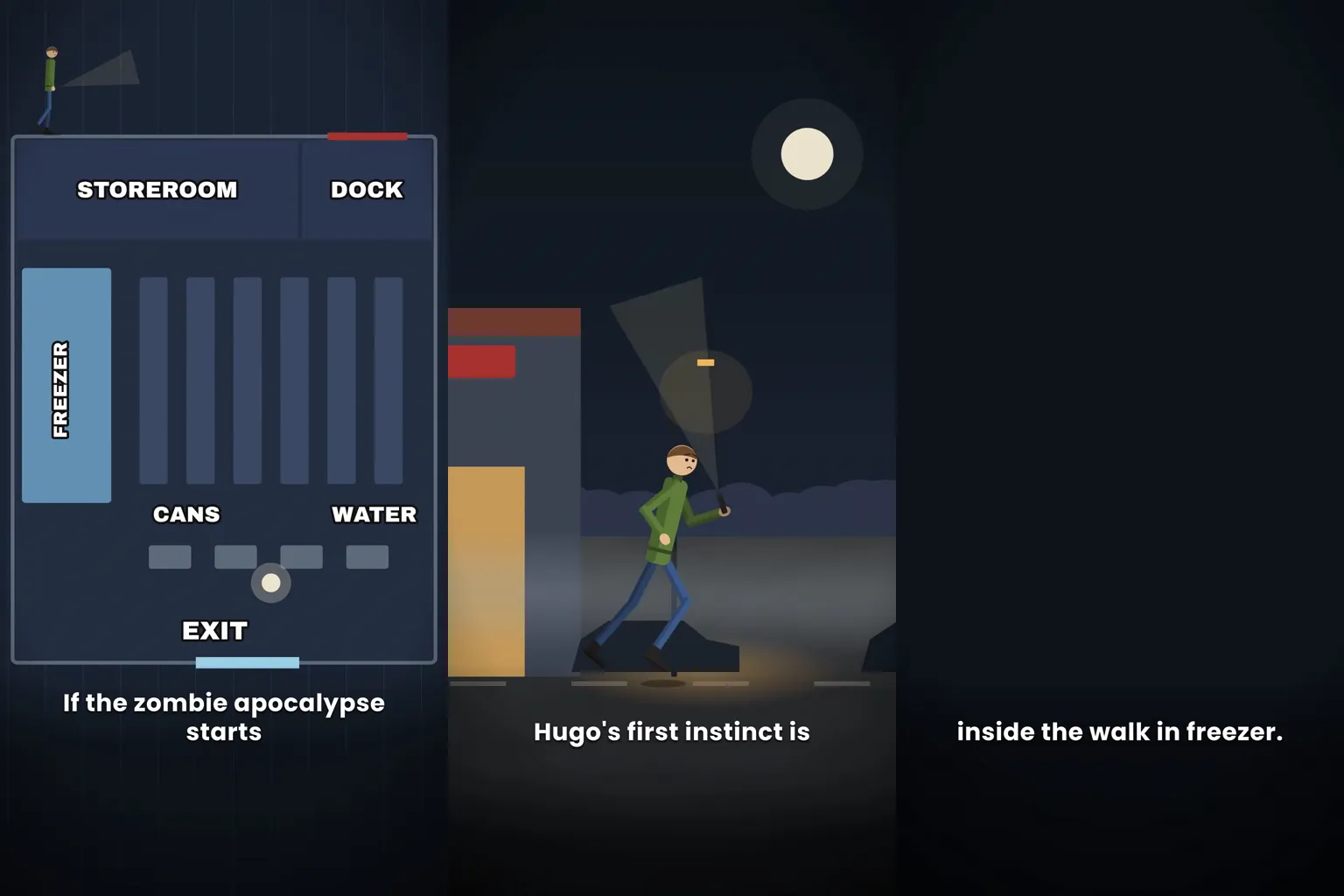
If the zombie apocalypse starts while you're in a supermarket, don't run for the exit. You're standing inside the place with the most food in the city. But only if you don't make one very stupid mistake. Hugo's first instinct is to run to his car. Don't. Everyone is out there. He has twenty minutes before people come to loot. First, the doors: they're automatic, and they open for anyone. If he cuts the power, they stay shut. But the freezers die too, and the meat lasts two days without cold. So he pulls down the metal shutter. And the whole neighborhood hears it. Inside there are twelve hundred cans, eight hundred bottles of water, and Tomás, who won't stop calling his wife. Hugo blocks the loading dock with pallets and starts counting. On paper, they could last for months. There was only one problem. Inside the walk-in freezer, someone started pounding on the door.
Every line has a job. The hook goes against instinct ("don't run for the exit"). There is a time limit (twenty minutes) and real mechanics (automatic doors, meat without cold). The mistake gets planted: the shutter is loud. There are numbers (1,200 cans, 800 bottles), a character who will cause trouble (Tomás and his wife) and an ending with a concrete threat.
Step 4: generate the episode
With the script approved, create the video. The Animation Studio plans the shots, animates the stick figures and the horde, records the voice, adds music and sound effects and burns in the captions. If you only want a one-off episode without building a channel, the stickman animation maker opens the Studio with the style already set.
This is our Part 1:
Step 5: make Part 2
Go back to the channel and write the next part: tell it in the topic what happened at the end of the last one. Part 2 has to make Part 1's mistake pay off and open a new problem. In ours, the one pounding on the freezer door is Lucía, the butcher, who has been hiding there for three hours. The noise of the shutter has brought a dozen infected to the front. And Tomás opens the loading dock for his wife, who does not come alone.
Since the cast lives in the channel, the characters look the same in every part.
Step 6: publish in other languages too
For another language, switch the channel's language (or make a channel in that language), pick a native voice and generate the episode with the translated script. Translating the finished video is not enough, because the map labels and the captions would stay in the original language. That is how we made the Spanish version of both parts.
How much it costs and how long it takes
Replicating the channel costs 65 credits, once. Each script the channel writes costs 12. Each 60-second episode, with narration, music, sound effects and captions, cost us 520 credits and took about 25 minutes to generate. The part that takes longest is reviewing the script, and it deserves more of your time than anything else.
What we learned by testing it
- AI video does not work for this format. Our first test animated frames with an AI video model, and it showed: the stick figures warped and it looked AI-made. Code animation is what gives these channels their look.
- Editing is not optional. A version with a few long shots is boring even with a good script. A cut every 2-3 seconds is part of the format.
- Check what the replica learns. The script notes drive every episode: read and fix them before you write Part 1.
- Do not copy the channel. Create your own characters, places and problems. The formula belongs to nobody; their stories do.
Frequently asked questions
Can you monetize stick figure videos?
Yes, if they are original. Your own story, with your own characters and settings, is original content. What you should not do is trace another channel's episodes. For more on earning from AI-made videos, see how to make money on YouTube without making videos.
Do you need to know how to animate?
No. Replicating the channel gives you the formula and the cast, the channel writes the script you review, and the Studio plans the shots, animates the stick figures, records the voice and edits the video.
Does it work with themes other than zombies?
The formula works for any survival story with practical decisions: a blackout, a shipwreck, a snowstorm, an invasion. What makes it work is the concrete problem and the cliffhanger, not the zombies.
How long should each part be?
About 60 seconds, which is what works best in Shorts and Reels and what the Studio generates in one go.
Start your series
The format is proven and the formula fits on one page. Paste the URL of the channel that inspires you into Replicate an Animated Channel, choose "Animated stick figures" and write your Part 1. For a one-off episode, use the AI stickman animation maker.